|
The Woodland Education Centre |
|
|
The Woodland Education Centre |
|
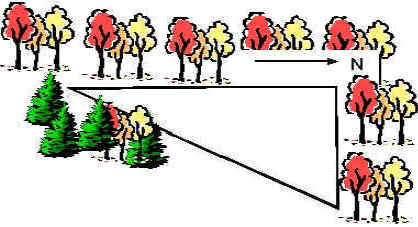
Diagram of the Heathland Restoration Project Site
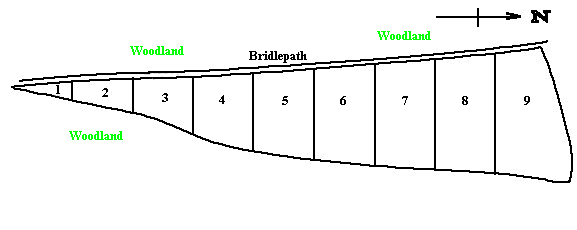 |
| Nine sections are marked out longitudinally from east to west up and down the slope. The demarcations are not actual physical boundaries, but are marked out at intervals with white post markers. Different sections have been assigned different management regimes. |
Management Details
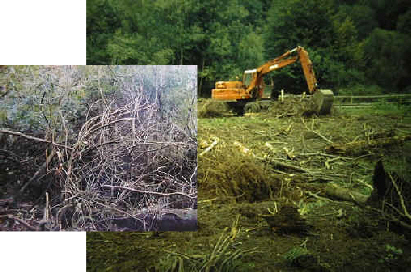
Some large tree stumps were mechanically removed during clearance. The resulting ground disturbance exposed the underlying greensand geology in several places, resulting in some noticeably different conditions in these small local areas of the site. Woodland clearance resulted in an explosion of growth from seed banks previously dormant in the soil. (This would have resulted in only partial depletion of the seed bank. Many dormant seeds would still have remained.) The initial regrowth consisted mainly of woodland species which would compete with regenerating heathland vegetation. This regrowth was therefore cleared by spraying with Roundup, which is a general purpose herbicide. This rendered the entire project site bare of vegetation, so that initially the site was superficially uniform. The second natural regeneration was then allowed to take place, beginning in the latter part of 1993. The nine sections subsequently demarcated on the heathland site are not uniform in terms of size, nor in terms of flora, since the sections at the boundaries of the area (1,2 and 8,9) are particularly influenced by adjacent woodland. This may affect both microclimate and soil conditions. These sections are also likely to have greater numbers of tree seedlings becoming established, due to proximity to the woodland. The top (western end) of each section may also be influenced by the deciduous woodland beyond the narrow bridlepath forming the boundary.
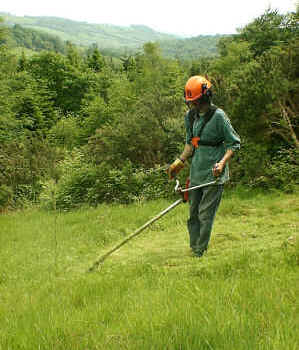
With these limitations in mind, different management regimes were assigned to each section, with the aim of promoting the natural colonization and establishment of heather and other characteristic heath species in one or more of the sections. To compensate for the considerable differences in size of the southern sections and the influence of the woodland boundary, sections 1 and 3 are duplicates of the same management regime, as are sections 2 and 4. Management regimes were initiated in the Autumn of 1995, after the second natural regeneration had taken place across the site. |
| Action>> | Spring Brushcut | Summer Brushcut | Autumn Brushcut | Roundup Herbicide | Garlon & Kerb | Handweed | Initiated |
| Section No. | - | - | - | - | - | - | - |
1 |
- | - | + |
- | - | - | Autumn 1995 |
2 |
+ |
- | - | - | - | - | Spring 1996 |
3 |
- | - | + |
- | - | - | Autumn 1995 |
4 |
+ |
- | - | - | - | - | Spring 1996 |
5 |
- | - | - | - | - | - | Control |
6 |
+ |
+ |
+ |
- | - | - | Spring 1996 |
7 |
+ |
- | - | - | + |
- | Spring 1996 |
8 |
- | - | + |
+ |
- | - | Autumn 1996 |
9 |
- | - | - | + |
- | + |
Garlon (used to control gorse) was sprayed once onto gorse in section 7 in May 1996. Kerb granules (which specifically act against grasses) were also applied in section 7 in December 1996. No further control has been applied using these substances since these initial applications. Roundup was selectively applied to a variety of plants viewed as undesirable (such as thistles and regenerating woodland species) in sections 8 and 9 in September 1996. Controlled application only to selected plants was achieved using a weed wiper. This operation was carried out once. Section 9 has been handweeded throughout the life of the experiment, whenever labour has allowed. Both staff and volunteer labour have been utilized to periodically remove some of the colonizing brambles and tree seedlings.
|
||||||
>> Continue to Ecological Survey Methods
Ecological Survey 2001 |