|
The Woodland Education Centre |
|
|
The Woodland Education Centre |
|
Conclusions
 |
The initial vegetation
cover on the project site was very heterogeneous. This was a direct consequence of the
extremely diverse seed bank which must have accumulated in the soil over many years.
Selective germination from this diverse seed bank, in response to differing environmental
conditions across the site, led to the production of a clearly non-uniform initial plant
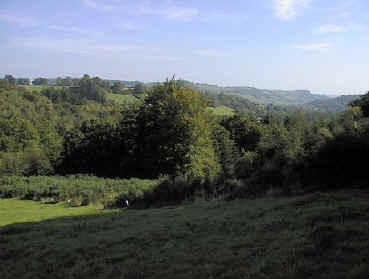
cover. left: view South East across the Heathland Restoration site. |
| The survey carried out in 1996 served as a base-line survey which identified
these initial vegetational differences, as yet unrelated to differing management
techniques in the sections. The initial heterogeneity of the vegetation is slowly declining, as those species favoured by current conditions spread and those which are unsuited, die out. (Current conditions on the site are the result of a combination of climatic factors and the prevailing management regime.) Overall, the vegetation on the project site is making slow but steady progress towards becoming a dry heath community. |
|
 |
The northern sections of the
project site (5 - 9) are more favourable for the development of heath species than the
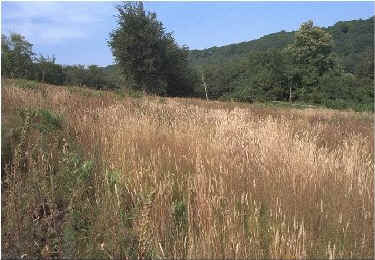
southern sections (1 - 4). The southern sections are heavily influenced by adjacent woodland and to date, show no sign of developing a heath-type community. left: view looking North across the Heathland Restoration Project site. |
| Differing management techniques have now resulted in clearly visible
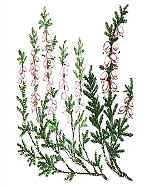
differences between strips with different management regimes. The control strip (5), which has been left untouched, provides a good example of what conditions would be like on much of the project site in the absence of any management. It is now dominated by gorse (Ulex europaeus) which is over head height (ca 2m tall), and by tree seedlings such as Silver Birch (Betula pendula), cherry (Prunus sp.), willow (Salix caprea agg. and S. aurita) and rhododendron (Rhododendron ponticum). The vegetation here forms a thick almost impenetrable cover, permeated by Brambles (Rubus fruticosus agg.) and with occasional grassy clearings where Heather (Calluna vulgaris) and Bell Heather (Erica cinerea) grow in isolated patches. The vegetation present on other sections of the site is the result of an amalgam of controlling factors. Local environmental factors primarily determine what is present, with modifications to this superimposed by differing management techniques. The southern sections, 1 - 4, show few clearly demarcated differences between them, except in the spring, when sections 1 and 3 are ablaze with Bluebells (Hyacinthoides non-scripta). Sections 2 and 4 are then visibly different because the Bluebells have greatly decreased in these spring brushcut areas. At other times of the year these strips form grassy meadows. The only really visible distinction between them is the presence of more tree seedlings and bracken in section 1 because of its close proximity to the adjacent woodland. So far, in this southern region, environmental factors are paramount in determining the vegetation cover. |
|
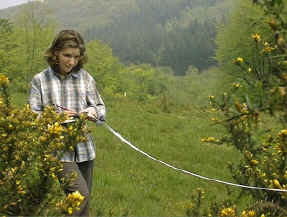 |
left: "A" level student conducting a survey on the Heathland Restoration Project site. |
Ecological Surveys 96 - 98 |