|
The Woodland Education Centre |
|
|
The Woodland Education Centre |
|
Ecological Survey 2001
These descriptions
build upon the descriptions of the sections given in the 2000 ecological survey and should
be read in conjunction for maximum benefit. |
Section 5 (Control)
Observations 2000 - 2001
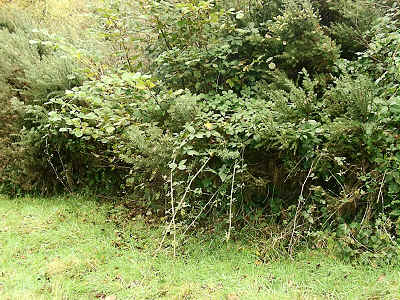 |
The control section was by
now mainly composed of very tall gorse, interspersed with young trees and interlaced with
brambles. The maximum height of the section had reached 4m in places. |
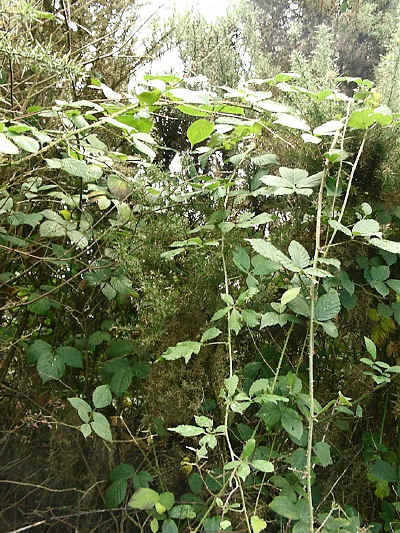 |
Where there was thick gorse and bramble, the only plants growing underneath were often Bugle and the mosses Eurhynchium praelongum and Thuidium tamarascinum. The mosses were not confined to the ground, but also colonized the trunks of the gorse. Bugle seems to be able to grow in particularly low light conditions, despite the fact that it is a creeping, ground herb, more often found in open, well lit habitats. The number of dominant species in this section had decreased from 11 in 2000 to only 6 in 2001. Violet, Soft Rush and Yellow Pimpernel had declined to almost nothing, while Common Bent and Raspberry had also decreased in abundance.
|
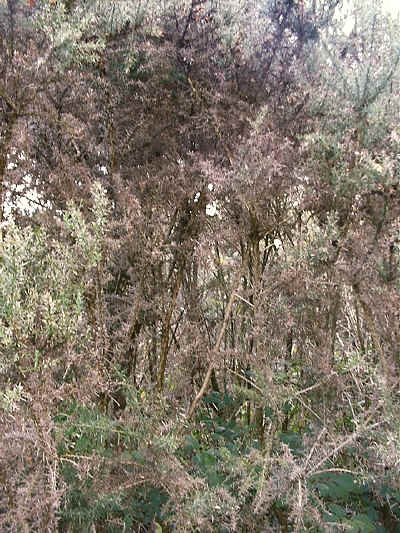 |
Gorse had increased
substantially in this section over the year. It fact, it was the only section where there
was a really significant change in gorse abundance. In places, the gorse was becoming very leggy (left). Generally only the top-most branches remained green, while all the ones underneath were dead. When these had fallen off, clearer more open areas were left underneath where light could get in, provided the bramble wasn't too thick and tangled. In these more open areas and in clearings where tree saplings predominated, there was more of a ground flora, composed largely of Common Bent, Green-ribbed Sedge and Bugle. |
 |
The upper half of the section
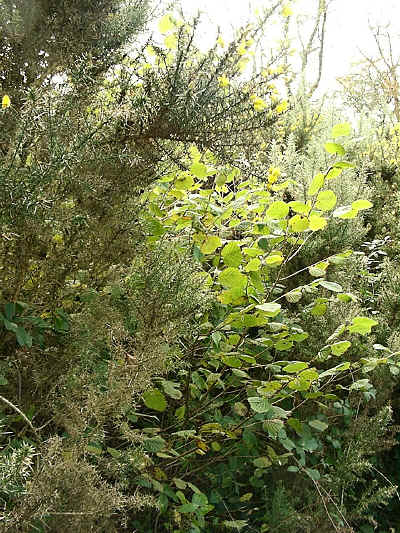
contained more tree saplings, including Hazel (left),Silver Birch, willows and cherry.
|
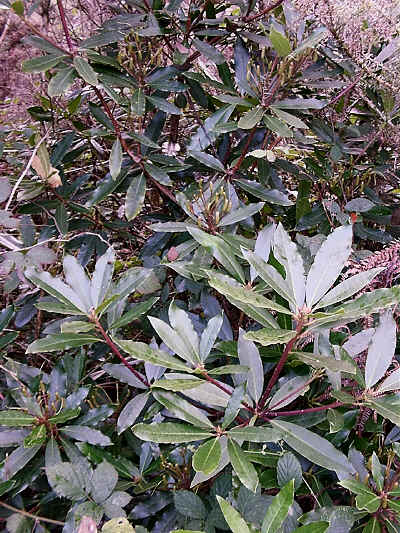 |
Rhododendron (left) was becoming well established in patches in amongst the other vegetation. |
Dominant Plants in
Section 5 in 2001
with figures from 2000 for comparison.
Characteristic heath species are in bold print
| Species | Overall % frequency | Mean % Cover (all quadrats) | ||
| 2001 | 2000 | 2001 | 2000 | |
| Bramble | 100 | 94 | 57 | |
| Eurhynchium praelongum | 69 | 88 | 42 | |
| Silver Birch | 35 | 60 | 27 | |
| European Gorse | 97 | 63 | 60 | |
| Thuidium tamarascinum | 53 | 41 | 26 | |
| Bugle | 36 | 35 | 4 | |
| Percentage frequency = the percentage of the total number of quadrats sampled over the whole site which contain the species. For example, a percentage frequency of 100%, means that the species was found in all quadrats sampled. |
>> Continue to Grass Charts
Ecological Survey 2001 |