|

|
The Woodland Education Centre
The Heathland Restoration Project
Contents |

|
Ecological
Surveys 1996 - 1998
Summary
Summary points 1-10 11-16 17-18 19-26
| The Heathland Restoration Project is concerned with restoring an area of
lowland heath in the Woodland Education Centre in Offwell, Devon, from conifer and
rhododendron woodland. Different management techniques are being used to identify which is
the most appropriate. |
 |
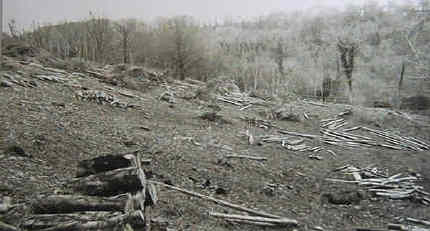
left: This former area of dense rhododendron and conifer woodland was cleared to
start work on restoring it
as a heathland habitat. This is the site of the Heathland Restoration Project
described in this report. |
- 1. The Woodland
Education Centre is a Forestry Commission site, created and managed by the Offwell
Woodland & Wildlife Trust. It covers an area of 50 acres.
Since 1986, the Centre has been restored from a virtually worthless rhododendron jungle to
an area of great ecological significance. A wide variety of different native habitats have
been restored.
|

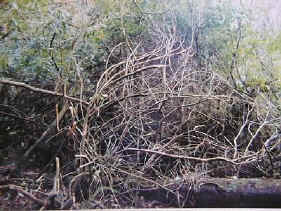
Rhododendron on the project
site. |
- 2. The site selected
for heathland regeneration covers an area of just over 2 hectares on the western boundary
of the Centre. It is bounded by woodland to the north, south and west. On the eastern
boundary is a cutting and path through the Education Centre, with coniferous woodland
beyond (map). It lies at an
altitude of approximately 200 metres.
- 3. The Heathland
Restoration Project site comprises a hillside sloping down from west to east. It has been
divided into nine approximately rectangular sections, with their long axes stretching from
west to east (diagram). The sections are not physically
separated from each other in any way, but are marked out with wooden boundary markers at
appropriate points.
- 4. The soil substrate is composed of a
thin top-soil, overlying greensand, which in some areas is completely exposed and lacking
in top-soil. Soil pH varies from 4 - 5 across the site.
- 5. The original
vegetation cover on the project site consisted of conifers and broad-leafed trees such as
Sweet Chestnut, with an understorey of Rhododendron. This was completely cleared in 1993.
(This work was funded by the Countryside Commission.)
|
| Clearance
resulted in an explosion of growth from seed banks previously dormant in the soil. (This
would have resulted in only partial depletion of the seed bank, many dormant seeds would
still have remained.) The
initial regrowth consisted mainly of woodland species which would compete with
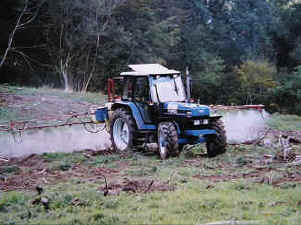
regenerating heathland vegetation. It was therefore cleared by
spraying with Roundup, which is a general purpose herbicide. This rendered the entire
project site bare of vegetation, so that initially the site was superficially uniform. |
 |
- 6.
The nine sections demarcated on
the heathland site are not uniform in terms of size (diagram),
nor in terms of flora, since the sections at the boundaries of the area (1,2 and 8,9) will
be influenced by adjacent woodland. This may affect both microclimate and soil conditions.
These sections are also likely to have greater numbers of tree seedlings becoming
established, due to proximity to the woodland. The top (western end) of each section may
also be influenced by the deciduous woodland beyond the narrow path forming the boundary.
With these limitations in mind, different management regimes were assigned to each section
with the aim of successfully promoting heather growth in one or more sections. To
compensate for their small size and the influence of the woodland boundary, sections 1 and
3 are duplicates of the same management regime, as are sections 2 and 4.
|
| Action>> |
Spring Brushcut |
Summer Brushcut |
Autumn Brushcut |
Roundup Herbicide |
Garlon & Kerb |
Handweed |
Initiated |
| Section No. |
- |
- |
- |
- |
- |
- |
- |
1 |
- |
- |
+ |
- |
- |
- |
1995 |
2 |
+ |
- |
- |
- |
- |
- |
1995 |
3 |
- |
- |
+ |
- |
- |
- |
1995 |
4 |
+ |
- |
- |
- |
- |
- |
1995 |
5 |
- |
- |
- |
- |
- |
- |
1995 |
6 |
+ |
+ |
+ |
- |
- |
- |
1996 |
7 |
+ |
- |
- |
- |
+ |
- |
1996 |
8 |
- |
- |
+ |
+ |
- |
- |
1996 |
9 |
- |
- |
- |
+ |
- |
+ |
1996 |
- 8.
Methods. The vegetation on the
heathland site was surveyed annually in July from 1996 - 1998. The 1996 survey acted as a base-line
survey of vegetation initially regenerating on the site (after the two prior clearances in
1993).
The site was surveyed by carrying out a
belt transect across the centre of the site, encompassing all sections from 1 through to
9. Additionally, in 1997 and 1998, random samples were taken within each section. Sampling
yielded data on the species present, their abundance ( % cover ) and maximum
height. This allowed comparisons to be made between the vegetation in sections under
different management regimes, as well as showing overall changes in the site vegetation
with time.
- 9.
Two different methods were used to survey
the site. A belt transect was carried out every year from 1996 to 1998. Random quadrats
were also sampled in 1997 and 1998. The results obtained using the two different methods
were in many cases quite different from each other. This illustrates the need to use the
same method of sampling when comparing results from different areas or over time. The
random quadrat data was judged to be the most accurate. The two sets of data taken
together provided a good picture of vegetation on the site.
- 10. A total of 90 species were recorded on the project site over the period 1996 -
1998. Most of these species were rare on the site.
|
Continue to points 11-16
|