Offwell Woodland & Wildlife Trust

Promoting the British Countryside

Home

About us Conservation Education Wildlife Habitats Maps Search Resources Sponsors

.
Typical Silage Production
An essential part of intensive grass farming is the preservation of grass as silage, for use in the winter
Click here to view a movie showing the stages of precision chop silage making

mowing1.jpg (86800 bytes)

>

sunanim2.gif (3725 bytes)

>

harvest.jpg (99572 bytes)

>

trailer6.jpg (26292 bytes)

>

buckrake 5.jpg (100254 bytes)
MOW WILT HARVEST TRANSPORT ENSILE

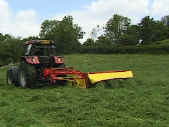
Mow the grass when the sugar levels are high i.e. In the afternoon. Grass sugar levels are also dependent on the type of grass and the stage of the crop. Ryegrass has higher sugar levels than other grasses, with Cocksfoot having the lowest.

Wilt the grass just enough to remove excessive moisture or add a chemical inoculant to the harvested crop to aid the ensiling process.

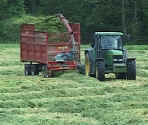
Use a precision chop harvester to pick up the cut grass and cut it into short lengths. The harvester then blows the grass into trailers. The harvester can be self propelled or powered by a tractor.

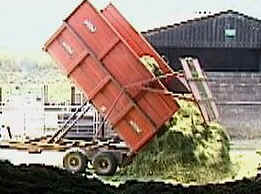
Transport the cut grass to where the silage is to be made. This will usually be in a building, covered yard or sometimes outside on a concrete base.

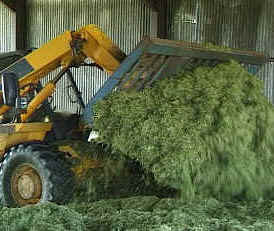
Fill the silage clamp as quickly as possible. Each load is spread thinly and compacted with the tyres of the loading machine so that the air is expelled. The natural bacterial process which then results is fuelled by the sugars in the grass. This process pickles the grass, preserving it as silage.

Continue


Copyright © Offwell Woodland & Wildlife Trust 1998/9 & 2000/1/2/3/4/5 http://www.offwell.info

All the information including images, charts, movies and sounds is provided copyright free, only for educational use by schools, colleges and universities unless you are making a charge. If you wish to use information or any part of this site for commercial purposes or for any purpose where a charge is made then you must get permission, so make sure you contact us first. Remember, if you are not a school, college or university you must obtain permission to use any part of this website. Note that company logos are reproduced with permission and remain copyright of their respective owners.