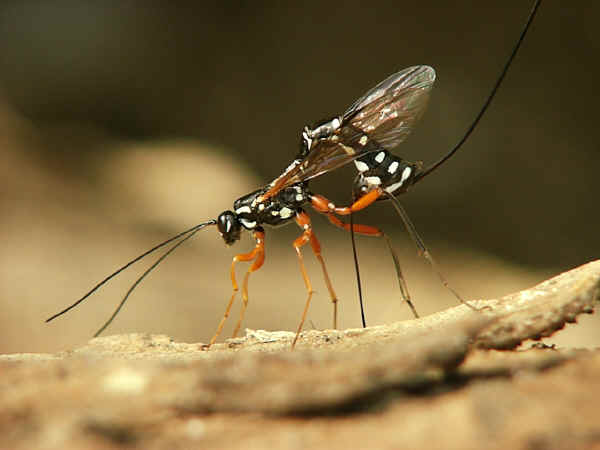
Sabre Wasp
Rhyssa persuasoria
| The Sabre Wasp is a type of insect called an Ichneumon
Fly. Ichneumons have a wasp waist, and often, long, flexible antennae. The apparently
fearsome-looking sting at the end of the female wasp's abdomen in the picture above, is
actually an ovipositor, rather than a sting. These insects are harmless to humans. The
adults feed on nectar from flowers and aphid honeydew. The ovipositor of the female is used to lay eggs deep within fallen timber. The picture above shows a female preparing to lay eggs in a log on the woodland floor. The long ovipositor is 40-50mm in length. It is like a hypodermic needle and is protected inside a long black sheath. It can penetrate wood with ease despite its delicate appearance. The female is feeling the timber with the antennae on the front of her head. She is searching for the leg-less larvae of another type of wasp, called a Wood Wasp, or Horntail. She locates them deep inside the timber, just from sensing vibrations. Once she has located a Wood Wasp larva, she will drill her ovipositor down through the timber and lay an egg on the outside of the larva. It may take her as much as an hour to complete the process. She is very vulnerable to other predators, such as birds, at this time. When the egg hatches, the Ichneumon larva will gradually consume the Wood Wasp larva.
|
Use your Back Button to return to the page you came from
