|
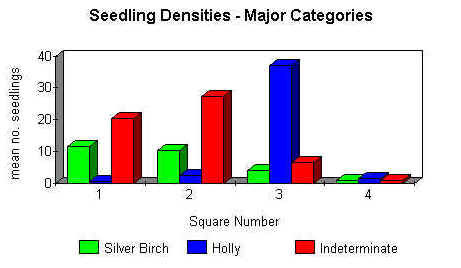
Figure 8. Densities of the Major Seedling Categories. |
Woodland Project Phase 2 Survey Report
Seedlings
| Major Categories Silver Birch seedlings were found in the greatest density in Squares 1 and 2 (Figure 8). Large numbers of seedlings too small to be identified with any confidence, were also found in Squares 1 and 2 (Figures 8 and 9A & B). It is likely that many of the indeterminate seedlings in these areas were also Silver Birch, so their density is probably much higher than that recorded. Their high density in this region reflects the fact that Silver Birch tree density was originally highest in these areas (Figure 3). |
|
Figure 8. Densities of the Major Seedling Categories. |
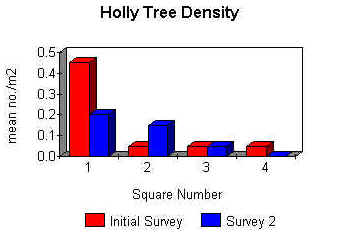
| Holly seedlings were present throughout the site, but occurred in greatest density in Square 3 (Figures 8 and 9 C). This region had one of the lowest densities of Holly trees overall (Figure 10), so proximity to the source of seed was not a factor. Holly seeds are to a great extent dispersed by birds which eat the berries. It may be that birds have tended to congregate in this area to digest the berries in preference to other regions. |
|
Figure 10. Holly Tree Density |
| The Holly seedlings in Area 3 were obviously of differing ages, with some
being much better developed than others. The high density of seedlings in this region may
also be a consequence of the fact that this region has three seasons-worth of developing
seedlings, rather than one, as in other areas. It should be noted that Holly seedlings are not included amongst the indeterminate category of seedlings, because they were immediately recognizable from the earliest cotyledon stage. There is therefore no possiblity that the greater number of seedlings in Square 3 is simply due to the fact that they were further advanced and therefore recognizable in comparison to other regions. There were very few seedlings of any of the major categories in Square 4 (Figure 8). However, this is more related to the fact that there were very few seedlings of any category in this region (Figure 7). As already stated this is likely to be because this area has had the least time to regenerate after raking and removal of the leaf litter. |
Woodland Project Phase 2 |
||
Results |
||