Offwell Woodland & Wildlife Trust

Promoting the British Countryside

Home

About us Conservation Education Wildlife Habitats Maps Search Resources Sponsors


Grass Identification

by Jean Turner

A guide to identifying grasses. Grasses are most easily identified when they are in flower, using a combination of floral and vegetative features. The structure of the flower heads is quite complex and must be clearly understood in order to be able to identify grasses. A x10 hand lens is useful for this. It is possible (although more challenging) to identify grasses even when they are not flowering. In this case, the structure of the leaves, together with the growth form of the overall plant, become the most important features (see Grass Structure below).

Grasses can quite easily be confused with members of two different families of flowering plants, the sedges and the rushes. The first step in identification is therefore to be sure which of these three superficially similar families of plants the specimen belongs to (see the Introduction below).

The most important features to look for when identifying grasses are given in the 'Ten Tips' section.

Contents

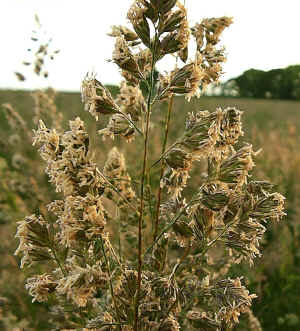
Cocksfoot Grass Inflorescence
1. Introduction
General features of grasses
Comparison with sedges & rushes
2. Grass Structure
Plant and Flower Structure
3. Ten Tips for Identification
What to look for when identifying grasses.


Copyright © Offwell Woodland & Wildlife Trust 1998/9 & 2000/1/2/3/4/5 http://www.offwell.info

All the information including images, charts, movies and sounds is provided copyright free, only for educational use by schools, colleges and universities unless you are making a charge. If you wish to use information or any part of this site for commercial purposes or for any purpose where a charge is made then you must get permission, so make sure you contact us first. Remember, if you are not a school, college or university you must obtain permission to use any part of this website. Note that company logos are reproduced with permission and remain copyright of their respective owners.